Panchavarnaswamy Temple, Uraiyur, Thiruchirapalli (#126)

Updated: Sep 19
பஞ்சவர்ணேசுவரர் திருக்கோயில், உறையூர், திருச்சிராப்பள்ளி
Uraiyur Uraiyur Uraiyur Uraiyur Uraiyur Uraiyur Uraiyur Uraiyur Uraiyur Uraiyur Uraiyur
Close to the centre of the city of Thiruchirapalli, is a suburb called Uraiyur. British colonial administrators misheard it as Woraiyur and recorded it as such in colonial records, giving it its current administrative name. Tucked away among its bustling streets is an ancient Sivan temple called the Panchavarneswarar or Panjavarneswarar temple. It is a Paadal Petra Sthalam.
Today, a small part of the large city of Thiruchirapalli, Uraiyur was once the capital of the Sangam era Cholas. Together with Pazhayarai, this was a centre of power for the early Chola kings. There is a legend that the Sangam era Chola king Karikalan was once wandering around Uraiyur astride his elephant, when the elephant went berserk as elephants are prone to do sometimes. Suddenly, out of nowhere a large rooster appeared, flew up to the elephant's forehead and furiously pecked it there. This miraculously calmed the elephant to the great relief of the panicked king. Thus the place came to be known also as Kozhiyur. Kozhi means chicken in Tamil. Other legends claim that it was an obscure Chola king called Veeravathithan who was thus saved by a rooster. In Thirugnanasampanthar's time, it was also called Thirumukkeeswaram. It is the birthplace of two early Chola kings Kochengatcholan and Pugalcholan, who are included among the 63 Nayanmar to honour their contribution to Saivite revival called the Bhakthi movement. The Alwar saint Thirupanazhwar was also born here.
The temple to Lord Sivan here is known as the Panchavarneswarar (the five-coloured Lord) due to the legend that he appeared here in five different colors at five different times in the day to the great sage Uthanga Munivar. Other legends claim that it was actually Lord Brahma who was thus blessed. The colours are believed to be golden yellow, white, red, black and smoke ash. In Tamil the Lord is also referred to as Aivanna Perumal. Some claim that the Sivalingam changes colour throughout the day even now. It might have done so at some time, due to the chemical composition of the stone and its reflective qualities, but it is not so obvious now. At least it is not perceptible to most people. When we were there the officiating priest told us that he has not seen the colour change in his 8 years working at the temple. According to him, only the very pious can perceive it and he did not belong in that league. The Sivalingam is a relatively small Suyambulingam (self-manifested lingam) that is kept covered by a copper kavasam or shield most of the time. This temple should not be confused with another temple with a similar legend where also the Lord is sometimes called the Panchavarneswarar. That temple is at Thirunallur (not Thirunallar) near Kumbakonam. There are a number of other legends, which is not surprising given the great antiquity of the temple.
According to oral history, it is believed that the temple was originally built by Kochengatcholan. He seems to have built a number of Sivan temples in the Kaveri area. They were brick and wood structures. This temple had been converted to a granite temple in the 10th century by later Chola kings. The temple contains eight sets of historically important inscriptions. There are inscriptions from the reigns of Rajarajan I and Rajendran I. Some of the inscriptions are from unnamed Chola kings. One inscription details the gifting of the tax revenue of a nearby village for the maintenance of the temple.
It is the 122nd Paadal Petra Sthalam and the 5th on the south bank of the Kaveri. It has been immortalised in Thevaram by Thirugnanasampanthar in the early seventh century. He sings thus:
சாந்தம்வெண்ணீ றெனப்பூசி வெள்ளஞ்சடை வைத்தவர்
காந்தளாரும் விரலேழை யொடாடிய காரணம்
ஆய்ந்துகொண்டாங் கறியந் நிறைந்தாரவ ரார்கொலோ
வேந்தன்மூக்கீச் சரத்தடிகள் செய்கின்றதோர் மெய்ம்மையே
( With his forehead adorned with the white sacred ash and with the river (Ganga) in his matted hair he dances with Uma who has beautiful fingers like the petals of the Kaanthal (Flame Lily or Gloriosa superba) flower. Why does he do so? What mysterious truth is he trying to reveal to us? This Lord of Mukkeeswaram)
Thevaram 2.120
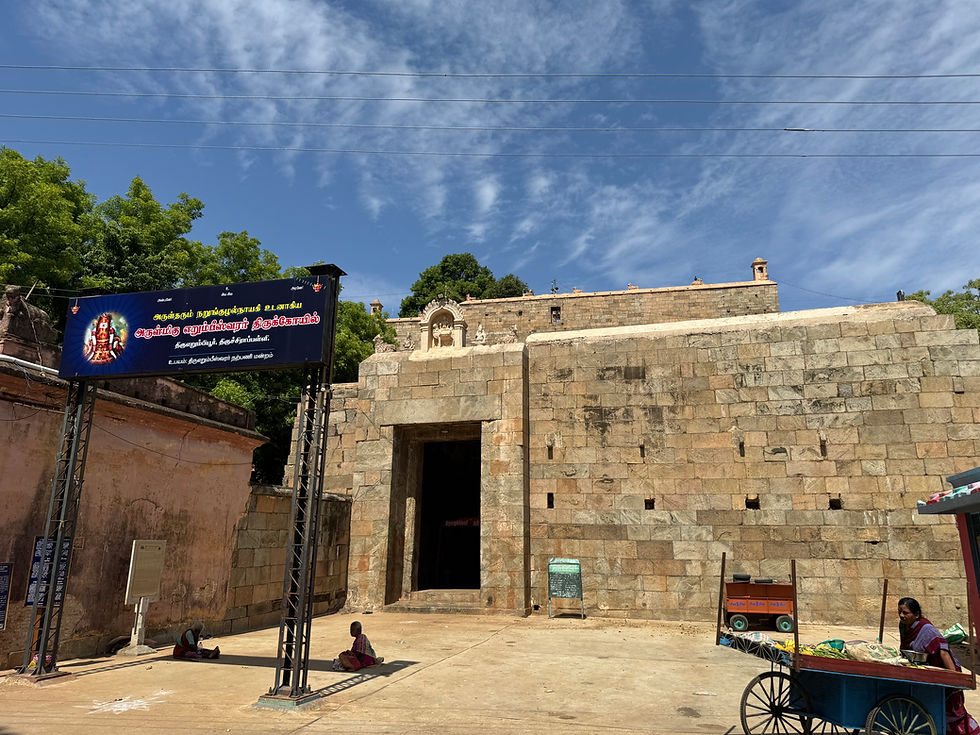
The temple has a five-tiered rajagopuram and three prakarams. It has a karuvarai, arthamandapam and mahamandapam. The pillars have exquisite granite carvings. The beautiful dvarapalakars adorning the entrance of the sanctum are from the eighth century. The temple is replete with Chola features. The rajagopuram is certainly suggestive of Nayakkan times but might be the product of modern renovation. The census reports of 1961 specifically mention that there was no rajagopuram. It likely has been rebuilt since then. There have been a number of renovation efforts in modern times. It is an east-facing temple with the shrine for the Goddess Kanthimathi facing south. The temple is owned and administered by the HR and CE department of the Government of Tamil Nadu.
The sthalavirutcham is the Vilva tree. There is a tank or stepwell inside the premises called the Sivatheertham which is the main theertham. There are many festivals celebrated throughout the year but the main one is the Brahmotsavam in Vaikasi (May/June). The temple is open daily from 5:30 to 12:30 in the morning and from 4:00 to 8:30 in the evening.
The temple is located in the city of Thiruchirapalli or Trichy about 10 km or 30 minutes northwest of the airport. We visited in July 2026. We were based in Thiruchirapalli.
Sources:
Dinamalar: Uraiyur Sri Panchavarneswarar Temple
P.K Nambiyar and K.C . Narayana Kurup, Census of India 1961. Volume IX. Part XI -D. Temples of Madras State. Thiruchirapalli and South Arcot Pages 199-200
Thevaram

Courtesy Google Maps


Comments