Sattanathar or Thoniappar Temple, Sirkazhi (#110)

Updated: Sep 7
சட்டநாதர் திருக்கோயில் அல்லது தோணியப்பர் திருக்கோயில், சீர்காழி
Sirkazhi Sirkazhi Sirkazhi Sirkazhi Sirkazhi Sirkazhi Sirkazhi Sirkazhi Sirkazhi Sirkazhi Sirkazhi Sirkazhi Sirkazhi Sirkazhi Sirkazhi Sirkazhi Sirkazhi Sirkazhi Sirkazhi Sirkazhi Sirkazhi
This much-celebrated and well-known Sivan temple is one of the most revered temples in the Tamil Saivite tradition. It is ancient and beautiful. It is a Paadal Petra Sthalam and with a whopping 71 pathigams, it is one of the five most celebrated temples in the Thevaram. It is the birthplace or Avathara Sthalam of the boy-saint Thirugnanasampanthar. The Lord here and the temple have 12 different names. There are three manifestations of Lord Sivan in the sanctum. The temple and Lord here are commonly referred to as Thoniappar, Sattanathar and Brahmapureeswarar. In recent times it is sometimes called Sattainathar. In ancient times the temple was also referred to as Thirukazhumalam.
The temple is closely associated with Thirugnanasampanthar. He was born here in this town in the early 7th century. When he was about 3 years old, his father Sivapatha Iruthayar took him to the temple and left him on the steps of the water tank and took a dip in the water. When he came out he noticed that the child's lips were white and he was holding a small bowl of milk. The infuriated father, upset that the child had consumed milk from a stranger, grabbed the dish and flung it at the temple walls. There is an indentation on the temple wall across from the Keni or water tank where people believe the Kinnam or bowl struck. Legend says that the child was crying when it lost sight of his father and Goddess Uma herself fed the child with her own milk to soothe him. The child turned out to be a prodigy and started singing Thevarams in praise of Lord Sivan from a young age, The more than 300 pathigams that he sang were later compiled into the first 3 Thirumurai of the Panniru Thirumurai, the Tamil Saivite canon.
The sanctum of the temple has 3 levels. At the ground level Lord Brahmapureeswarar takes the form of a Sivalingam with Goddess Thirunilainayaki as his consort. The second level, accessible by a flight of steps, houses a massive sculpture of the Lord in the Umamaheswarar form with Goddess Periyanayaki by his side as his consort. He is known as Thoniappar or Periyanayakar. The idol is placed on a boat. "Thoni "means a boat in Tamil. Legend says that during one of the great deluges that engulfed the earth, Lord Sivan collected the 64 Arts and carried them in a raft or boat to save them from being lost. It is believed to have happened here. Thus he came to be known as Thoniappar, the Lord of the Boat. From the second level a set of stairs go up to the third level where Lord Sivan manifests in the Bhairavar form and is called Sattainathar or Sattanathar in ancient times. "Sattam" means law in Tamil. A grand view of the temple and surroundings can be experienced from the upper two levels. There is also a legend that Lord Sivan once wore Lord Vishnu as his Sattai or upper garment or shirt to quell his arrogance.
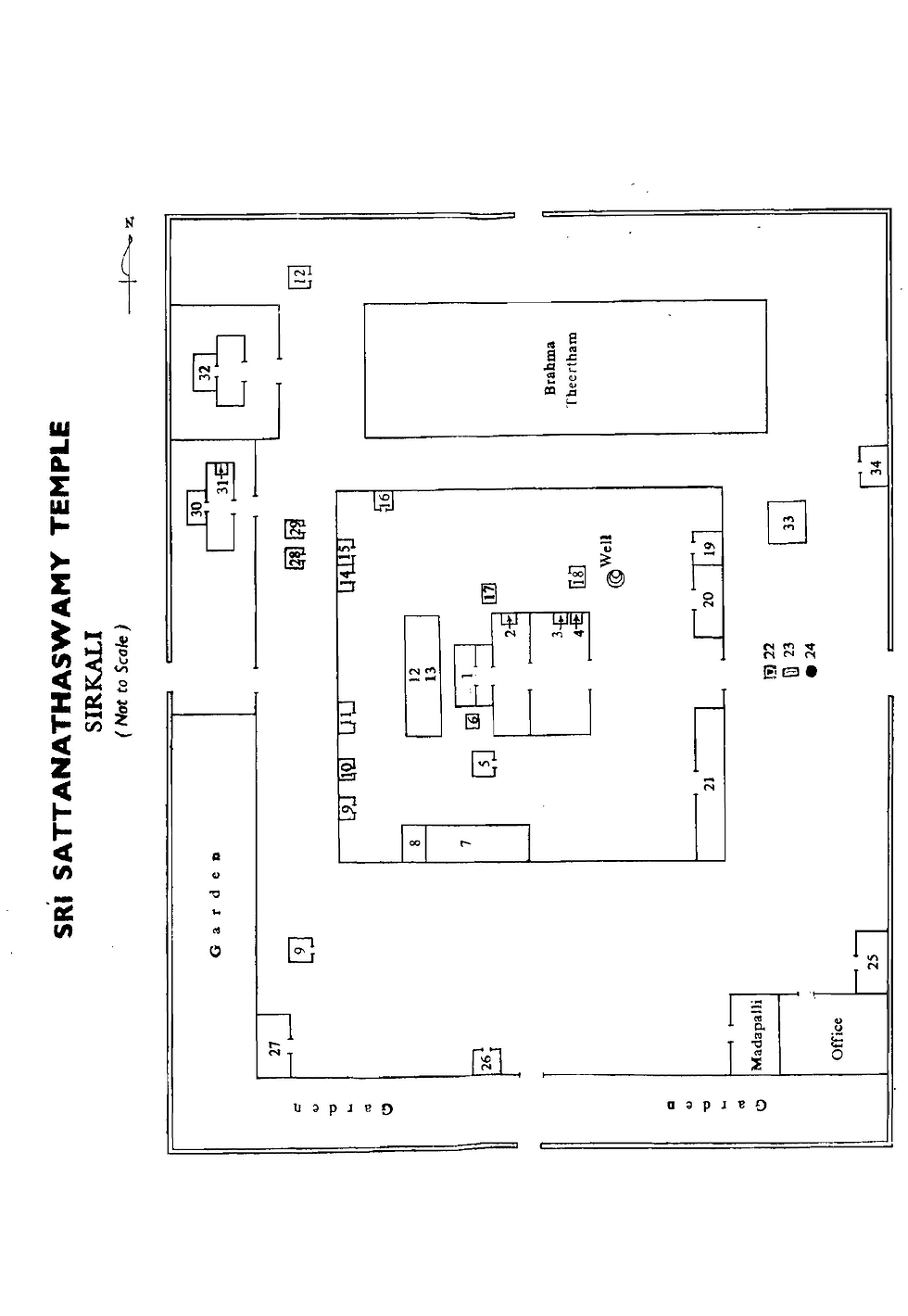
The temple has spacious and long prakarams. Although the exact area is unclear, it is a moderately large temple. There are 22 waterbodies or theerthams associated with it. The main theertham is called Brahmatheertham. which is within the temple premises. There are two temple trees or sthalavirutchams, the Parijatham and the Pavalamalli. The temple is associated with Bhairavar worship and there is a Bhairavar shrine with the eight aspects of Bhairavar called the Ashta Bhairavar Sannidhi. There are three main sanctums within the complex. The sanctum sanctorum housing the 3 tiered Brahmapureeswarar, Thoniappar and Sattanathar shrines is central. In the northwest corner of the complex, is the shrine for the consort Thirunilainayaki. Between these two shrines, there is a shrine for Thirugnanasampanthar. There are lofty gopurams at the entrances in all four cardinal directions. It is an east facing temple. The Utchavar is Somaskandar.
There are 47 sets of important inscriptions here. The inscriptions span 6 centuries from Vira Rajendra Cholan (1063 -1070) to the Vijayanagar king Venkatadevarayar (1598). They not only list the kings and benefactors who donated to the expansion of the temple at various times, but also give us an insight into the customs, practices and traditions of the people at that time. It is believed that in Thirugnasampanthar's period, the three parts of the main sanctum were in different areas of the temple. The current configuration started evolving in the 11th century onwards. Other kings mentioned in the inscriptions include, Kulothungan I (1070-1120), Kulothungan II (1136 -1150), Rajarajan II (1136 -1150), Rajadhirajan II (1163 -1175), Kulothungan III (1179-1216), Rajarajan III (1216-1246), Sundarapandiyan (1251-1270) and Krishnadevarayar (1509 -1529).
The major festival or Brahmotsavam occurs in the Tamil month of Chithirai (April/May). The second day is known as the Thirumulaippal Festival and commemorates the event of Thirugnasampanthar's consumption of Parvathi's divine milk. There are several other festivals throughout the year. In olden times, it was customary for men to visit without an upper garment and bare chested and women did not wear flowers on their hair. These rules are not strictly adhered to anymore. The temple's day-to-day affairs are administered by the Saivite monastic institution, the Dharmapuram Adhinam.
It is the 68th Paadal Petra Sthalam and the 14th sthalam on the north side of the Kaveri River. It has a large number pathigams in its praise. The Moovar, Thirugnanasampanthar, Thirunavukkarasar and Sundarar as well as Manickavasagar have praised this temple in song. It is said that Sundarar refused to set foot inside the temple because he thought that his feet would desecrate such a sacred site. He praised it in Thevaram from outside the town.
Thirugnanasampanthar's first thevaram and the first thevaram of the entire Thirumurai was sung here:
தோடுடைய செவியன் விடையேறியோர் தூவெண்மதி சூடிக்
காடுடையசுட லைப்பொடிபூசி என் உள்ளங்கவர் கள்வன்
ஏடுடையமல ரான்முனைநாட்பணிந் தேத்தஅருள் செய்த
பீடுடையபிர மாபுரம்மேவிய பெம்மானிவ னன்றே.
(He wears a ring in his ear lobe, he rides a bull, he has the pure white crescent on his head, he owns the forest, he wears the ash of the cremation ground on his forehead, he is the thief who steals my heart, he has the book of the Vedas, he was worshipped by Lord Brahma in this esteemed Brahmapuram where he resides, he is my Lord)
The temple is located 3 hours or 150 km northeast of Thiruchirapalli and 1.5 hours or 100 km south of Pondicherry. It is 1.5 hours or 60 km northeast of Kumbakonam and 1 hour 35 km north of Tharangambadi. We visited in June 2025. We were based in Kumbakonam.
Sources:
Dinamalar Temples - Sattainathar Temple, Sirkazhi (Tamil)
N. Chockalingam 1971, Census of India 1961. Volume IX. Part XI -D. Temples of Tamil Nadu Pages 9-15
Shaivam.org - Thevaram


Courtesy Google Maps


Great write up about the temple. Visited in 2020. Wish I had this information!!