Umamaheswarar Temple, Konerirajapuram or Thirunallam (#113)

Updated: Sep 7
உமாமகேசுவரர் திருக்கோயில் கோனேரிராஜபுரம் அல்லது திருநல்லம்
Konerirajapuram Konerirajapuram Konerirajapuram Konerirajapuram Konerirajapuram Konerirajapuram Konerirajapuram Konerirajapuram Konerirajapuram Konerirajapuram Konerirajapuram Konerirajapuram Konerirajapuram
This quiet Sivan temple in the Chola heartland is packed with historical and religious significance. A Paadal Petra Sthalam, it was an important Sivasthalam much before the ascent of the Imperial Cholas. But its significance also stems from its association with Sembiyan Mahadevi, Chola queen and temple builder par excellence. The village used to be called Thirunallam in ancient times. Konerirajapuram is a name that was given in later eras. The temple is often referred to as the Natarajar temple because of the massive bronze of Lord Nataraja here. Commissioned by Sembiyan Mahadevi, it is one of the oldest Nataraja idols this deep in the Chola country. Umamaheswarar is a compound of Uma and Maheswarar, symbolising the unity of the feminine and masculine, Shakthi and Sivan in Saivite Hindu belief systems.
Legends say that when the Nataraja idol was first commissioned, the sculptor struggled to get it to perfection. He was a devoted believer in Lord Sivan. One day he was deeply engrossed in his work when an old couple approached him and asked for some water to drink. The annoyed sculptor told them that he did not have any water but only had molten metal. They asked whether they could drink it and before the sculptor could react, they had both drunk it. And, lo and behold, they turned into beautiful idols of Lord Nataraja and Goddess Sivakami. When the king visited the next day, he did not believe the tale and struck the idol with his sword and to his terror, the idol bled. The mark of the sword is still there. Thus, the sculpture is believed to be of divine origin and not man-made.
It is said that when King Gandaradityan and his young bride Sembian Mahadevi visited the Natarajar temple in the Thillai forest for the first time, the young princess was so taken up by the idol that she wanted the same idol close to home. Thus the Natarajar bronze came to be installed here at Thirunallam when she became a powerful queen in later years. The temple is an example of early Chola architecture. Although added to in later eras, it has retained its Chola character. Sembiyan Mahadevi made extensive renovations here in memory of her husband, the king who became an acetic, Gandaraditya Cholan, after his death in the mid 10th century. Present in the 7th century as a brick structure, it was entirely rebuilt by Sembiyan Mahadevi into a granite building. It was reconsecrated in 973.
There are a number of valuable inscriptions dated to the periods of Gangaraditya Cholan, Uthama Cholan, Rajaraja Cholan I, Rajendra Cholan I, Rajadhiraja Cholan I, Rajendra Cholan II, Kulothunga Cholan I, Kulothunga Cholan III, Rajaraja Cholan II and Rajaraja Cholan III. These inscriptions describe donations and contributions towards the upkeep of the temple by various benefactors over the centuries. The temple was also extensively renovated by Vijayanagar rulers in the 15th and 16th centuries.
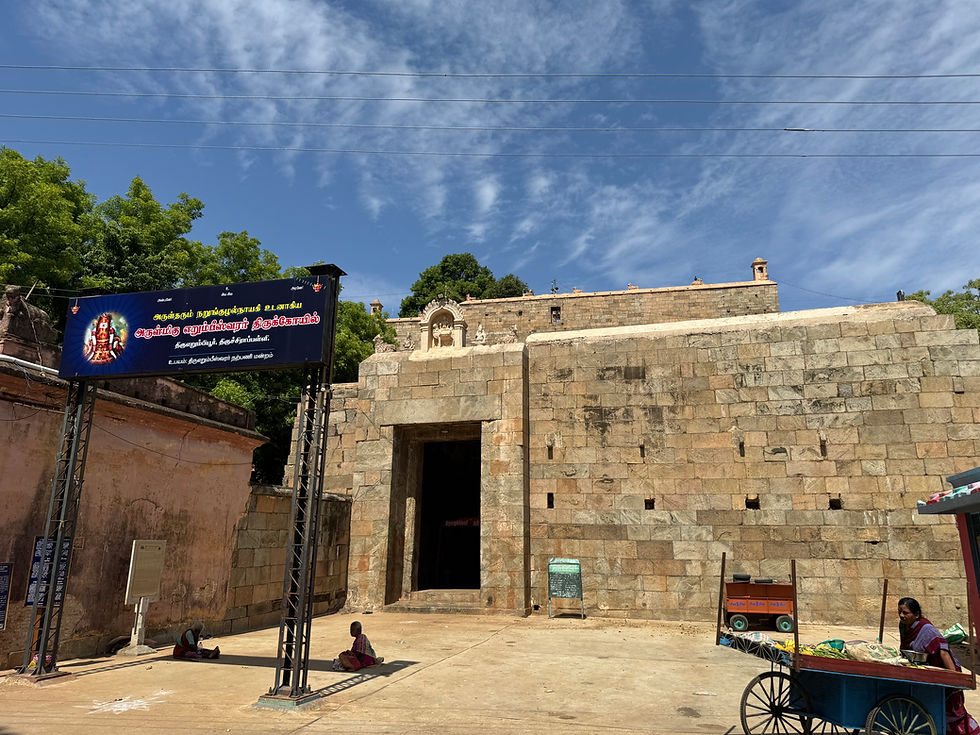
The temple is facing west which is unusual. West facing temples are rare. Most temples face east with very few facing other directions. There is no rajagopuram. There is a 3 tier, second level gopuram. There are two prakarams. The square shaped Karuvarai has 4 pillars supporting it, representing the 4 Vedas. It is topped by a beautiful vimanam that is 8 sided and curvilinear and is of an Ashtadwarapala design. It is not part of the initial construction and is a later addition, perhaps installed during Vijayanagar times. The sanctum is occupied by the presiding deity, Lord Umamaheswarar in Sivalingam form. The idol is 4.5 feet tall. On the southern, inner wall of the prakaram, there is a 10th century bas-relef sculpture of Gandaraditya Cholan and Sembiyan Mahadevi with a set of inscriptions below it. They mention that Queen Sembiyan Mahadevi renovated the temple in memory of her husband. The back koshtam has a Lingothbavar flanked by Lord Vishnu and Lord Brahma, representing the trinity and is also unusual. The famous, large Nataraja bronze is housed in a shrine of its own in the prakaram to the left of the sanctum as you face it. It is 8.5 feet tall and 5.5 feet in width. There is a beautiful bronze of Goddess Sivagami beside it. The temple is known for its large collection of exquisite Chola bronzes. The Amman, Angavalanayaki or Mangalanayaki has her own elaborate shrine facing east in the outer prakaram.
This is the 151st Paadal Petra Sthalam and the 34th on the south side of the Kaveri River. Thirugnasampanthar and Thirunavukkarasar visited here and rendered Thevaram pathigams.
Thirugnanasampanthar extols thus:
கல்லால் நிழல்மேய கறைசேர் கண்டாவென்
றெல்லா மொழியாலும் இமையோர் தொழுதேத்த
வில்லால் அரண்மூன்றும் வெந்து விழவெய்த
நல்லான் நமையாள்வான் நல்லம் நகரானே
(The celestial beings worship and praise Him in all the languages known, as the one who teaches under the Kallala banyan tree and has a stain on his throat. He burnt and destroyed the 3 fortresses of the Asuras with his bow and arrow, He is good and he rules over us. He dwells here at Nallam)
Thevaram 1.085
The sthalavirutchams are the Arasamaram (Peepal tree or Sacred Fig) and the Vilvam. There are two. The Vilvam here strangely has 13 leaves to every stem. Of the four theerthams associated with the temple, the large and beautiful Sakthi Theertham is found just outside the temple complex. The Saneeswarar shrine here is very special and the idol is clothed in white garments and not black as it is customary elsewhere. There are two Brahmotsavams, The Vaikasi Visakam in May/June and the Margazhi Thiruvadhirai in December/January. The Vaikasi Visakam festival is the more important one, when hundreds of devotees from surrounding villages congregate with much fervour.
The temple is located about 120 km or 2 hours east of Thiruchirapalli and 150 km or 3 hours south of Pondicherry. It is 22 km or 30 minutes east of Kumbakonam and 30 km or 1 hour southwest of Mayiladuthurai. We visited in June 2025. We were based in Kumbakonam
Sources:
Dinamalar Temples - Uma Maheswarar Temple, Konerirajapuram
N. Chockalingam 1971, Census of India 1961. Volume IX. Part XI -D. Temples of Tamil Nadu: Thanjavur Pages 71-72
Thevaram
Shaivam.org
Anirudh Kanisetti, Lords of Earth and Sea - A History of the Chola Empire. Pages 43-53

Courtesy Google Maps


Comments