The Cave Temples of the Rockfort, Thiruchirapalli (#125)

Updated: Sep 24
மலைக்கோட்டை குடவரைக்கயில்கள், திருச்சிராப்பள்ளி
Upper Cave Thiruchirapalli Rockfort Upper Cave Thiruchirapalli Rockfort Upper Cave Thiruchirapalli Rockfort Upper Cave Thiruchirapalli Rockfort Upper Cave Thiruchirapalli Rockfort Upper Cave Thiruchirapalli Rockfort Upper Cave Thiruchirapalli Rockfort Upper Cave Thiruchirapalli Rockfort Upper Cave Thiruchirapalli Rockfort Lower Cave Thiruchirapalli Rockfort Lower Cave Thiruchirapalli Rockfort Lower Cave Thiruchirapalli Rockfort Lower Cave Thiruchirapalli Rockfort Lower Cave Thiruchirapalli Rockfort Lower Cave Thiruchirapalli Rockfort Lower Cave Thiruchirapalli Rockfort Lower Cave Thiruchirapalli Rockfort Lower Cave Thiruchirapalli Rockfort
The active temples of the Rockfort complex in Thiruchirapalli (Trichy) are well known. Thousands visit them every day. But there are two cave shrines here dating back to the 7th century that are rarely visited and their location and significance are not known to many. One is known as the Upper Cave and is in plain sight but closed to the public most of the time. The other is known as the Lower Cave and is a bit harder to find as its access is hidden. These are inactive or dead temples administered by the ASI. Aesthetically and historically, the Upper Cave is thought to be the more important monument here.
The Upper Cave Temple:
This ancient cave temple is located just above the Thayumanavar temple on the way to the Uchipillayar Temple. As you ascend the flight of steps towards the summit, it is to the left set into the wall. It is usually closed by blue grill doors.
Also known as the Lalitankura Pallava Griham or Lalitankura Pallaveswaram, inscriptions here clearly attribute this temple to the Pallava king, Mahendravaram I (600-630 CE). Lalitankura ("the Handsome One") is one of his many titles. There are many inscriptions, one of which is a Sanskrit poem written in Grantha on one of the columns that is believed to be a composition by the king himself. He was a great poet and lover of the arts.
The cave is excavated midway up the hill and faces the Kaveri River to the north of it. It has an entrance that is supported by four pillars or columns and two pilasters at either end. There is an inner set of the same kind of columns and pilasters enclosing a mandapa. The pillars or columns here are of classic Mahendravarman type with cubical bases and top parts with an octagonal "kattu" in the middle. They have the signature lotus motifs. Inside there is an east-facing sanctum flanked by classic Mahendravarman era Dvarapalakars. The sanctum is devoid of a deity. It likely housed a Sivalingam. The western wall has a bas-relief of Lord Sivan as Gangadharan (கங்காதரன்) or " bearer of the Ganga" sculpted into it. It is believed to be one of the finest depictions of it kind from that era and was carved into the living rock towards the end of Mahendravarman's rule.
Symbolically the Gangadhara sculpture might depict the Pallava conquest of the important Kaveri region. In that time, the plains below would have been peaceful and sparsely populated. Today a bustling, crowded city of more than a million people sprawls at the base.
The cave signifies the furthest south that the Pallavas ruled directly. It is historically significant for this reason. There are monuments further south that Pallava vassals built. Being at the centre of a strategic fortress, it has seen its share of conflict over the ages and resulting damage.
The cave temple is closed to the general public by the ASI. This is understandable given the ugly habit of many people to vandalise important heritage sites by etching their names and initials onto these monuments. As this is located in a high traffic area, it is especially vulnerable. You can enter only by special permission or by chance if ASI staff are present at that time. They are rumored to visit about twice a week. This is unfortunate as it denies the responsible general public the opportunity to visit a very important historical monument. The better solution would be to ticket the monument and employ a security guard to protect it from vandals.
The Lower Cave Temple:
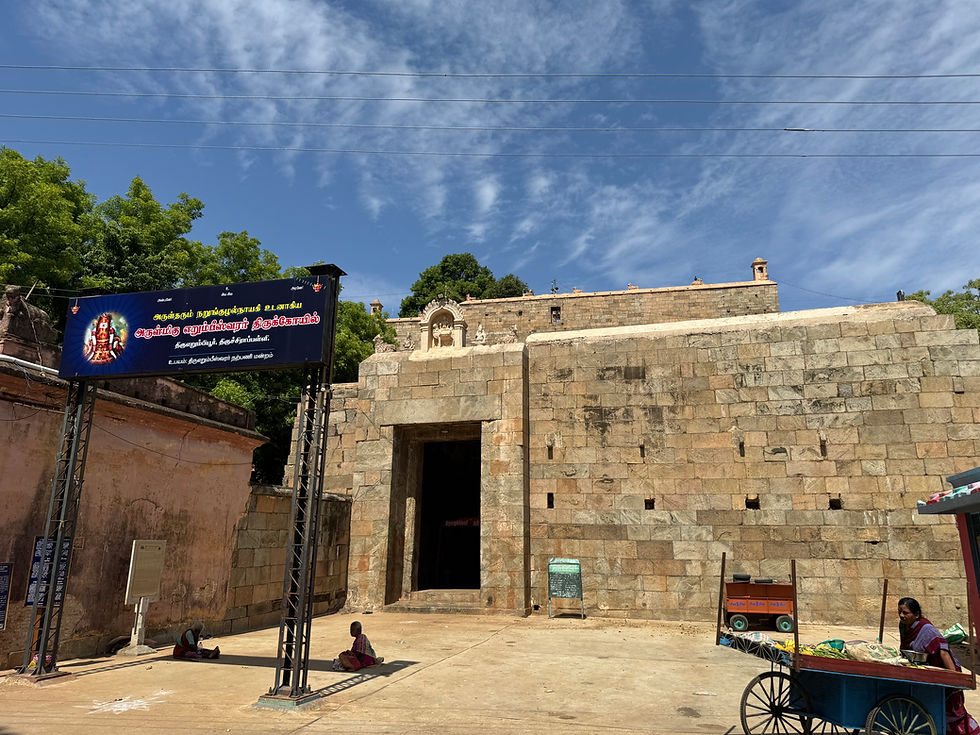
This cave is at the base of the Rockfort complex. It appears to have been built a few decades after the Upper cave. It is located to the left of the main entrance. The entrance to the cave temple is not well marked and somewhat difficult to find.
It is believed to be a Pallava temple built during the reign of Narasimhavarman I or Mamallan, son and successor of Mahendravarman I. The signboard put up by the ASI describes it as such. Some historians dispute that and claim that it was likely built by contemporary or later Pandiyan kings. There is not enough inscriptional evidence to settle the disagreement.
The cave has an entrance adorned by four pillars and two pilasters at either end with another set further inside enclosing a long mandapam. There are two sanctums at either end. One likely housed a Sivalingam that is missing. The other has a relief of Lord Vishnu sculpted onto the wall. There are five niches on the back wall. From left to right as you face them, the niches contain figures of Lord Ganesha, Lord Surya, Lord Brahma, Lord Subramanya and Goddess Durga as Kotravai, the Goddess of War. The art here is not believed to be as refined and of high quality compared to other sculptures of the same era. Some are not complete and others have sustained damage from the ravages of nature and human destruction. They are still beautiful.
This cave temple is reached from the Anai or Yanai Pathai or Elephant Way, a narrow lane running at the base of the Rockfort. If you enter from the main entrance and go past the Manikka Vinayagar temple (you might have to carry your footwear in your hands), you will come across the Yanai Pathai before crossing to the entrance of the steps leading up to the Thayumanavar. You turn left at the Yanai Pathai and walk about 200 metres. The temple is located at the end of a small alley to your right leading towards the base of the hill. It is not well marked. There is a nondescript sign on the side of the street that says ASI. You might miss it. You have to ask someone where the Kudavarai Koil is located and they will show you. At the end of the alley on your left, there is large open space protected by a fence and a gate. If you are in an autorickshaw or small car you may be able to reach the entrance of the alley directly by coming up the Yanai Pathai. The temple opens at around 9 am and is open all day. There were no staff when we visited mid morning and the site is not ticketed. The place was deserted with no people at all except for two kids playing cricket in the courtyard.
The Rockfort complex is in the heart of the city of Thiruchirapalli or Trichy. Thiruchirapalli is 332 km to the southwest of Chennai and is well connected by modern highways, rail and air. It has an international airport. We visited in August 2026. We were based in Thiruchirapalli.
Extenal links: Courtesy Youtube and V. Sriram (Historian)- https://youtu.be/YT0iPx409Sg?si=jJgdREOKH1wPdx1l
Sources:
Subramanian Swaminathan - Lalitankura Pallava Griham, A neglected Pallava treasure on Tiruchirappalli Rockfort Indian-Heritage.org
Krishnakumar T.K Pallava Cave Temples of Trichy - Indian Columbus

Courtesy Google Maps


Comments